Bulbophyllum
Bulbophyllum falcatum€22.00
 −28%
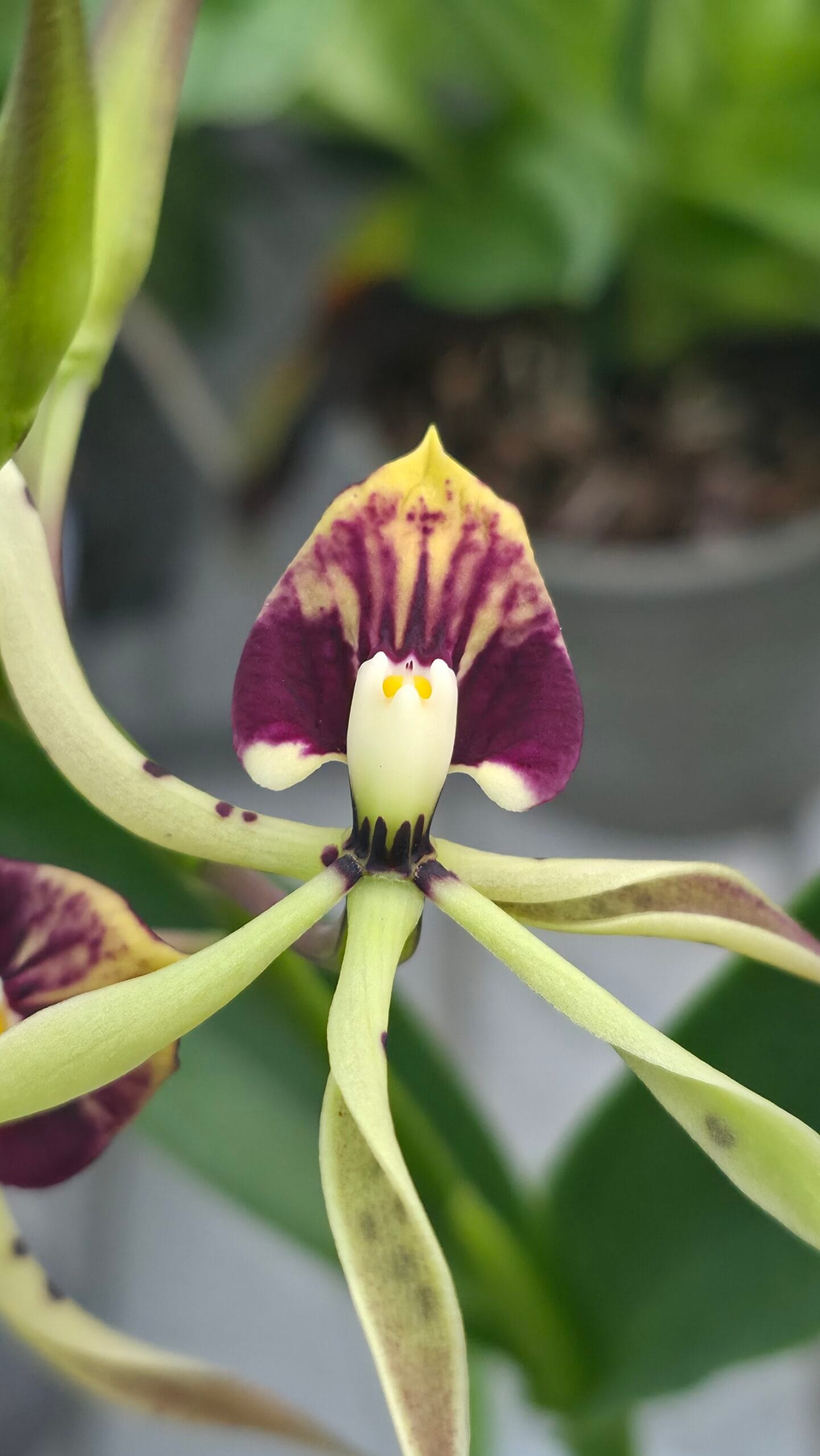
The Trigonidium obtusum is an extraordinary botanical orchid, highly sought after by collectors who appreciate exotic species with unusual flower shapes. Native to the tropical forests of South America, this species stands out for the singular architecture of its flowers, whose sepals fuse to form a triangular calyx in a golden-bronze or brownish shade with subtle longitudinal veining. The Trigonidium obtusum draws attention in the orchid collection not only for its rarity, but also for the fascinating botanical mechanism of its flowers, which mimic the presence of insects to attract natural pollinators in the wild.
Indeed, the charm of botanical plants lies in their authentic appearance and their evolutionary history. By growing the Trigonidium obtusum, you will have in your collection a specimen of great botanical value, characterised by compact sympodial growth, ovoid pseudobulbs and very elegant bright green foliage. Moreover, it is a rather generous orchid when kept in the right conditions, producing multiple upright flower spikes that rise directly from the base of the pseudobulbs during the flowering season.
To ensure that your Trigonidium obtusum grows with maximum vigour and flowers regularly, it is essential to replicate the conditions of its natural Atlantic forest and rainforest habitat. Below, we summarise all the key care requirements for light, temperature, watering and substrate.
The Trigonidium obtusum thrives ideally in moderate, filtered light (shade of between 50% and 60%). As it is a forest understorey species, it should be protected from direct sun to avoid scorching of the foliage. A well-lit east-facing window or a sheltered shelf in the orchid collection provides the perfect brightness to keep the leaves a healthy green.
This orchid adapts perfectly to intermediate to warm climates, preferring temperatures between 16°C and 28°C. It tolerates seasonal temperature variations in Portugal well, as long as it is kept protected from cold winds or frost in winter. Gentle, continuous ventilation is essential to keep the environment fresh and prevent fungal diseases.
During the active growth phase in spring and summer, the Trigonidium obtusum appreciates constant moisture in the substrate without becoming waterlogged. Water regularly as soon as the top layer of the substrate begins to feel dry to the touch. In winter, reduce the frequency of watering slightly, but without allowing the pseudobulbs to become excessively dehydrated. Keep the relative humidity between 60% and 75%.
The substrate should provide excellent moisture retention without compromising the oxygenation of the roots. We recommend a balanced mix of fine to medium grade pine bark, sphagnum moss and perlite. This species also responds very well to being grown in porous clay pots or mounted on natural cork.
Regular feeding supports the formation of new pseudobulbs and provides the energy needed to produce flower spikes. During the leaf and root development phase in spring and summer, add the fertiliser Orchid Focus Grow to the watering water. As the new pseudobulbs mature and approach the period of flower induction, switch to Orchid Focus Bloom to encourage more abundant and vigorous flowering.
Discover these products in our complete range of orchid fertilisers and foliar feeds. For more information on the taxonomic classification of the species in the genus Trigonidium, you can consult the Royal Horticultural Society (RHS) database.
Add the Trigonidium obtusum to your collection and be amazed by the fascinating geometry of this jewel of tropical botany!
News from our greenhouse in Fernão Ferro, for people who grow with passion.
By subscribing, you accept our Privacy policy. You can unsubscribe at any time.