

Description
Trigonidium obtusum: The Botanical Fascination of Triangular Flowers ✨
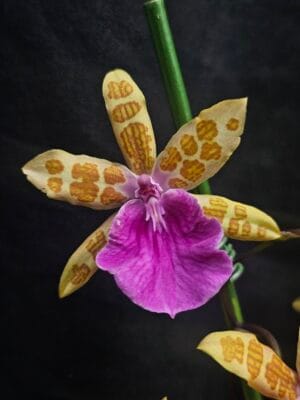
The Trigonidium obtusum is an extraordinary botanical orchid highly coveted by collectors who appreciate exotic species with unusual floral shapes. Native to the tropical forests of South America, this species stands out for the unique architecture of its flowers, whose sepals fuse to form a triangular calyx of a golden-bronze or brownish hue with subtle longitudinal veins. The Trigonidium obtusum draws attention in the orchidarium not only for its rarity, but also for the fascinating botanical mechanism of its flowers, which simulate the presence of insects to attract natural pollinators in the wild.
Indeed, the charm of botanical plants lies in their authentic appearance and evolutionary history. By cultivating the Trigonidium obtusum, you will have in your collection a specimen of great botanical value, characterized by compact sympodial growth, ovoid pseudobulbs, and very elegant bright-green foliage. In addition, it is quite a generous orchid when kept under proper conditions, producing multiple erect floral spikes that rise directly from the base of the pseudobulbs during the flowering season.
✨ Main Characteristics of Trigonidium obtusum
- Unique Triangular Flowers: The Trigonidium obtusum produces solitary flowers on erect spikes with an unmistakable triangular shape and tiny internal petals with metallic reflections.
- Exotic Coloration and Waxy Texture: It features a warm color palette ranging from brownish-yellow, bronze, and cinnamon tones, with a firm texture and excellent floral durability.
- Compact and Clumping Habit: It develops prominent pseudobulbs arranged along a short rhizome, forming dense and balanced clumps ideal for medium-sized pots.
- High Value for Collectors: It is a rare botanical species in the commercial market, perfect for those looking to diversify their orchidarium with exotic plants.
🌱 Practical Cultivation Guide for Trigonidium obtusum
To ensure that your Trigonidium obtusum develops with maximum vigor and blooms regularly, it is essential to simulate the conditions of its natural habitat of Atlantic forest and humid woodland. Below, we summarize all the fundamental care instructions regarding lighting, temperature, watering, and substrate.
1. Ideal Lighting and Location
The Trigonidium obtusum grows ideally under moderate and filtered light (50% to 60% shading). As it is a forest understory species, it must be protected from direct sunlight to prevent foliage burns. A well-lit east-facing window or a protected shelf in the orchidarium provide the perfect luminosity to keep the leaves a healthy green shade.
2. Temperature and Ventilation
This orchid adapts perfectly to intermediate to warm climates, preferring temperatures between 16°C and 28°C. It shows good tolerance to seasonal thermal variations in Portugal, provided it is kept protected against cold winds or winter frost. Gentle and continuous ventilation is essential to keep the environment fresh and prevent fungal diseases.
3. Watering and Air Humidity
During the active growth phase in spring and summer, the Trigonidium obtusum appreciates constant moisture in the substrate without becoming soggy. Water regularly as soon as the top layer of the substrate begins to dry to the touch. In winter, slightly reduce the watering frequency, but without allowing the pseudobulbs to dehydrate excessively. Maintain relative air humidity between 60% and 75%.
4. Substrate and Repotting
The substrate must ensure excellent moisture retention without compromising root aeration. We recommend a balanced mixture of fine-to-medium grade pine bark, sphagnum moss, and perlite. This species also responds very well to cultivation in porous clay pots or mounted on natural cork.
🧪 Nutrition and Recommended Fertilization
Regular fertilization supports the formation of new pseudobulbs and provides the energy needed for the emergence of floral spikes. During the foliage and root development phase in spring and summer, apply Orchid Focus Grow fertilizer to the watering water. As the new pseudobulbs mature and approach the floral induction period, switch to Orchid Focus Bloom to stimulate more abundant and vigorous flowering.
Discover these products in our complete range of orchid fertilizers and foliar nutrients. For more data on the taxonomic classification of species within the genus Trigonidium, you can access the database of the Royal Horticultural Society (RHS).
Add the Trigonidium obtusum to your collection and be amazed by the fascinating geometry of this tropical botanical jewel!


Reviews
There are no reviews yet